
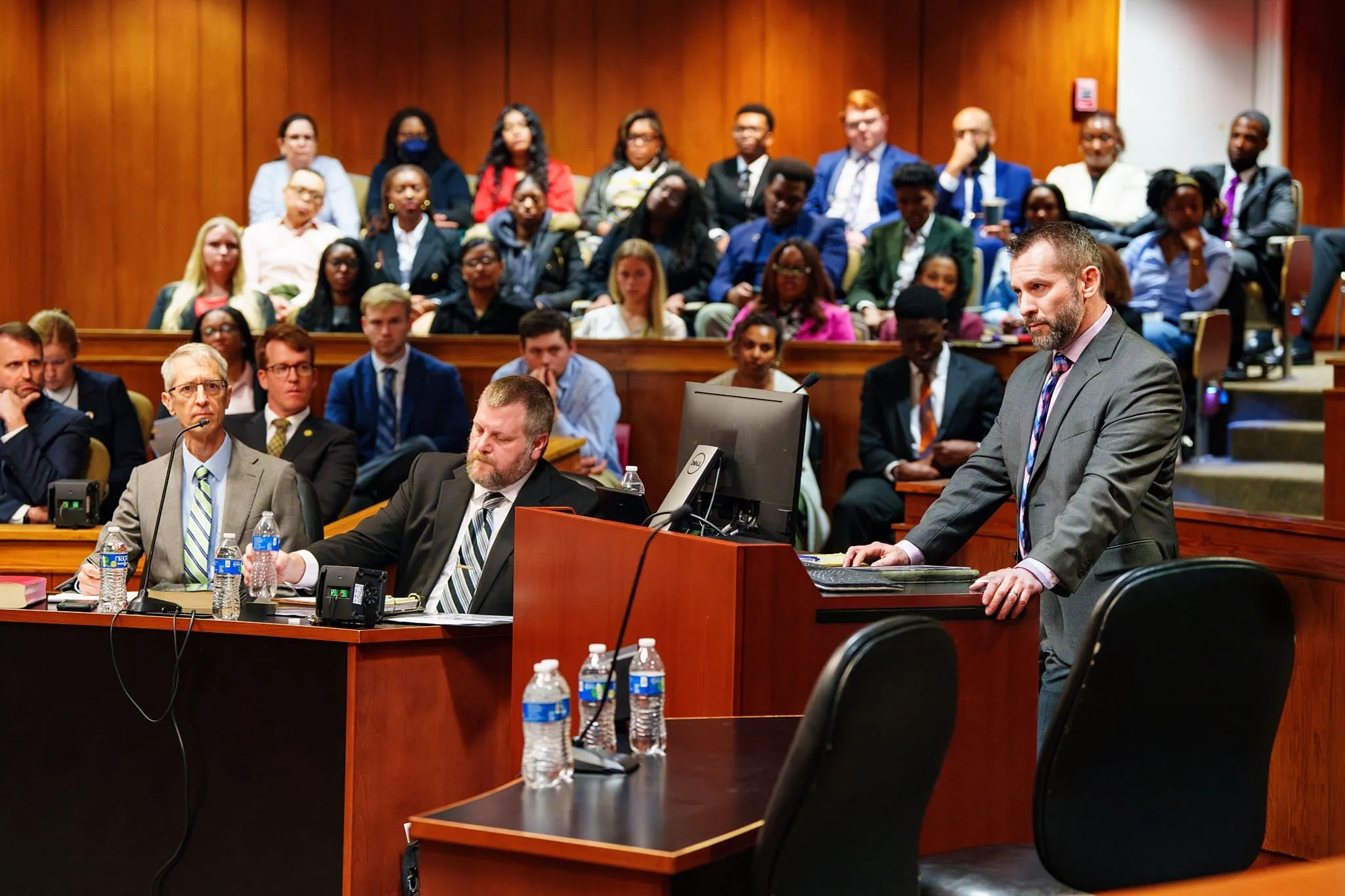
How to Present Your Argument Before a Judge
Your goal in the oral round is simple: make the judge understand, trust and agree. You do this by being clear, calm and courteous, and by making each point easy to follow.
How to address the bench
The correct title depends on the moot. Ask your coach and read the rules. Common forms:
| Moot setting | Usual way to address the judges |
| International court moots (Jessup, Stetson, Henry Dunant) | “Madam President / Mr. President, Members of the Court” and “the Court” |
| Arbitration moots (Vis) | “Madam Chair / Mr. Chair, Members of the Tribunal” and “the Tribunal” |
| Domestic moots | Often “My Lord / My Lords / My Lady”. Some organizers prefer “Honorable Court” |
Good habits:
- Never use a judge’s first name and avoid saying “you”. Say “the Court” or “the Tribunal”. (“Does the Court have the moot problem?” not “Do you have the moot problem?”)
- Call your opponent “my learned friend” or “counsel for the Respondent”.
- Call your teammate “my co-counsel” or “my learned colleague”.
- Say “I am grateful” instead of “thank you” if the moot is very formal.
- Avoid “I think”, “I feel”, “in my opinion”. Say “It is submitted”, “The Applicant submits”.
- Use polite, formal language, but plain words. Formal does not mean long.
The opening: a simple formula
Formal greeting + Who you are and who you represent + Who your teammate is and what they will cover + Offer a short summary of the facts (only if the rules or judge want it) + Roadmap: the points you will makeExample (first speaker for Torsa, an Applicant):
“May it please the Court. My name is [Name], and with my co-counsel, [Name], I appear for the Applicant, the Kingdom of Torsa. I will address the first two issues: whether the Rupa Water Treaty is still in force, and whether Ulka breached it. My co-counsel will address the general law on transboundary harm and the remedies. Would the Court like a short summary of the facts?”
Roadmap. Tell the judges your points in one sentence each. This is the most important minute of your speech.
“My Lord, I make two submissions. First, the treaty is still in force, because Ulka’s email was neither written notice to Torsa nor given in time. Second, Ulka breached Article 4 when it cut the flow below 40 percent.”
Keep the roadmap short, and make each point a real claim, not just a topic name.
How to present each submission
Use a pattern like this. Do not make it sound robotic.
- SIGNPOST: “Turning to my first submission…”
- CLAIM: Say the answer in one sentence.
- WHY IT MATTERS: How this helps win the case.
- RULE + SOURCE: The law, with the authority.
- APPLICATION: How it fits our facts.
- MINI-CLOSE: Repeat the claim in one sentence. Pause.
Example:
“Turning to my first submission: the treaty is still in force. If it is, Ulka is bound by Article 4 and its case ends. Article 12 requires written notice to the other party one year before expiry. Ulka sent one email to one ministry official, in October 2022. [Pause.] That was not notice to the State of Torsa, and it came late. The treaty therefore renewed automatically. Unless the Court has questions on this first submission, I turn to my second.”
How to cite sources orally
In a round, you cannot read a full footnote. Use this short routine when you take the judges to a source.
- Why: “In support, the Applicant relies on…”
- Name: Say the name in a natural way (Pulp Mills, not the whole citation).
- Location: “…at paragraph 101” or “bundle page 14”. Wait while the judges find it.
- Quote or summary: “The Court said that a State must…” Read the key line only, slowly, or paraphrase it accurately.
- So what: “It follows that Ulka had a duty to…”
If the moot uses a bundle, say the page number first so the judges can turn there while you speak. A good rule of thumb is one full source reference every five minutes. Use quick references (just the case name) for well-known points, and full references only for the key passages. Always keep the paragraph or page number ready in case a judge asks.
If you are reading a quote, say who said it (“the Court observed”). If you paraphrase, say so (“in summary, the Court held”). Never put your own opinion inside a quote.
How to refer to facts
Give a paragraph number, for example “paragraph 10 of the Moot Problem”. Judges often ask, “Where does it say that?” Keep your fact sheet in front of you. If the facts do not say it, say “The facts do not state that, but the reasonable inference is…”
How to deliver
| Skill | What to do | What to avoid |
| Speed | Slow and steady. Pause after key points | Racing to fit more content |
| Volume and clarity | Speak to the back of the room. Finish every word | Mumbling, swallowing endings |
| Eye contact | Look at the judges often, each in turn. Look at the person who asked a question while you answer | Staring at your notes or at one judge only |
| Notes | Glance, then look up. Keep notes at chest level so they do not block your face | Reading line by line |
| Hands and body | Stand straight. Keep hands still or rest them gently on the podium | Waving hands, swaying, leaning |
| Tone | Calm, firm, respectful. Vary your pitch so you do not sound flat | Over-dramatic speeches or sarcasm |
| Filler words | Pause instead | “Um”, “like”, “basically” |
| Time | Check the clock quietly | Saying “because I am short of time” (it shows poor planning) |
Believe your case. You were given your side. You may personally think the other side is right. Do not show it. Judges cannot trust a speaker who sounds unsure of their own argument.
Plain language wins
Use simple words and short sentences, even when the law is complex. Judges are not impressed by difficult English. They are impressed when a hard idea sounds easy.
- Not: “It is incumbent upon the Respondent to demonstrate that the said notification was transmitted in conformity with the procedural requirements stipulated.”
- Better: “Ulka must show that its notice followed the treaty’s rules. It did not.”
The conclusion
If you have time, close with a one-line summary of each submission.
“To conclude, the treaty remains in force, and Ulka breached it. For these reasons, Torsa requests the Court to declare…”
Then say the closing line the rules or your coach prefers, such as “Unless I can assist the Court further, those are my submissions.” Pause briefly in case there is a final question. Then sit down.
A short list of formalities
- Stand when speaking and when judges enter or leave (unless rules say otherwise).
- Never interrupt a judge. Wait until the question is finished, even if you know the end.
- Never interrupt your opponent. Take notes instead and answer in rebuttal.
- Keep phones silent and out of sight, unless the rules allow a timer.
- Be polite to everyone: judges, opponents, timekeepers, organizers. Judges notice.
Copyright remains with the authors unless stated otherwise.
About the author

Founder, DraftLaw Research, Lund University